Wilmington, DE, United States, Sept. 09, 2026 (GLOBE NEWSWIRE) -- Brands Delaying Recyclable Packaging Transition may soon face Structural Supply and Margin Risks
A decade of cost-led purchasing has obscured what is now happening on the supply side of the Flexible Packaging Market. The capability gap between converters who invested in barrier science and recyclable structures and those who did not has stopped being marginal. It has become the difference between winning shelf space and losing it. Brand owners treating film selection as a line item are discovering the assumption no longer holds.
Regulatory pressure on multi-material laminates and the parallel push toward mono-material recyclable formats have reorganized which suppliers can actually serve large accounts. What looks externally like incremental product evolution is, structurally, a redistribution of who controls the high-margin specifications. Companies that read the flexible packaging market as stable are negotiating against competitors who already see it moving, and that gap compounds each quarter.
Request a Free Sample Report: https://marketmindsadvisory.com/request-sample/?report_id=18
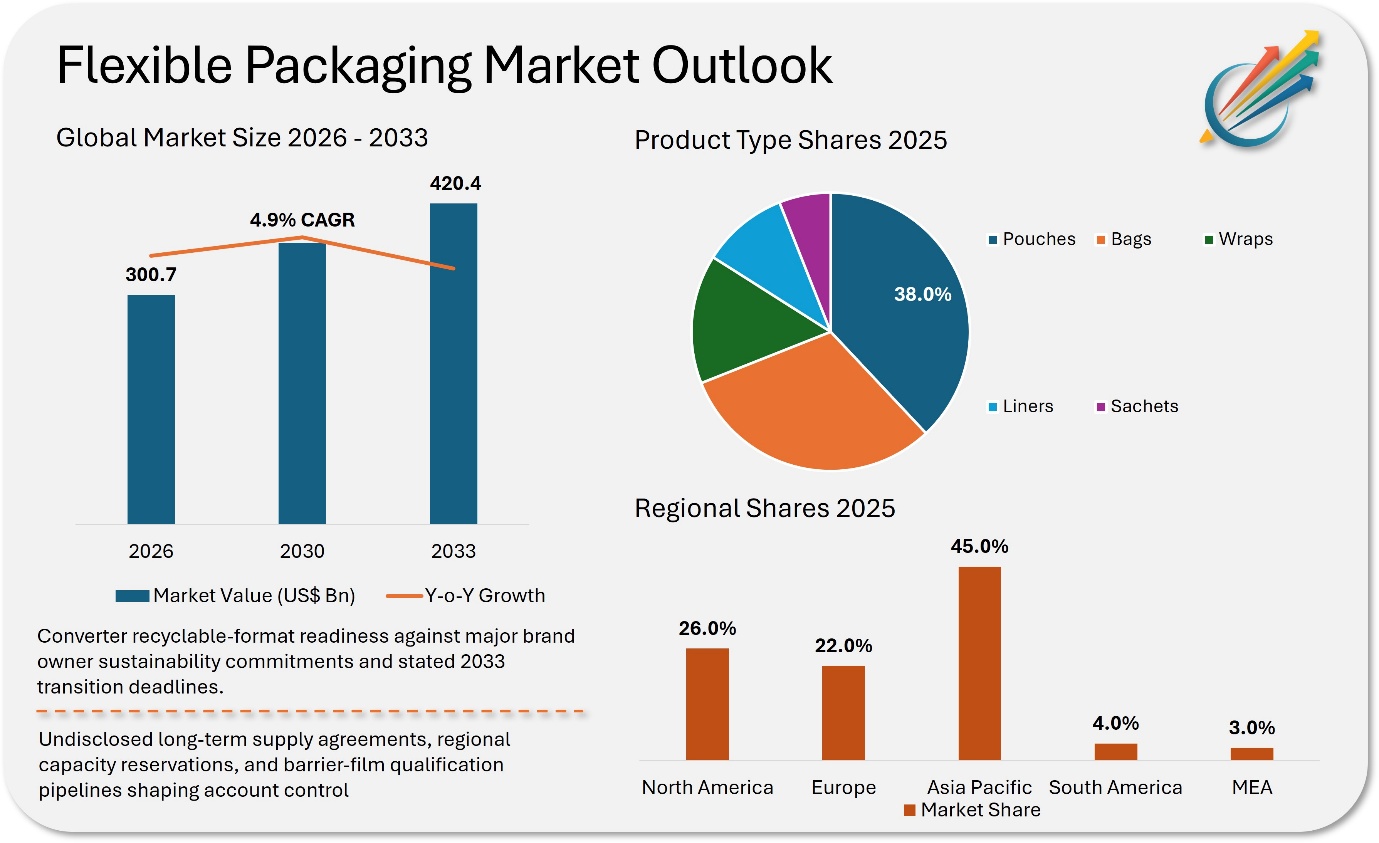
Key Takeaways from Flexible Packaging Market
- The flexible packaging market is projected to reach US$ 420.4 Billion by 2033, up from US$ 300.7 Billion in 2026.
- The market is expanding at a CAGR of 4.9% across the 2026 to 2033 forecast period.
- Mono-material recyclable structures are shifting from pilot programs to mainstream account requirements.
- Food and beverage applications continue to anchor volume, but pharmaceutical packaging is driving margin expansion.
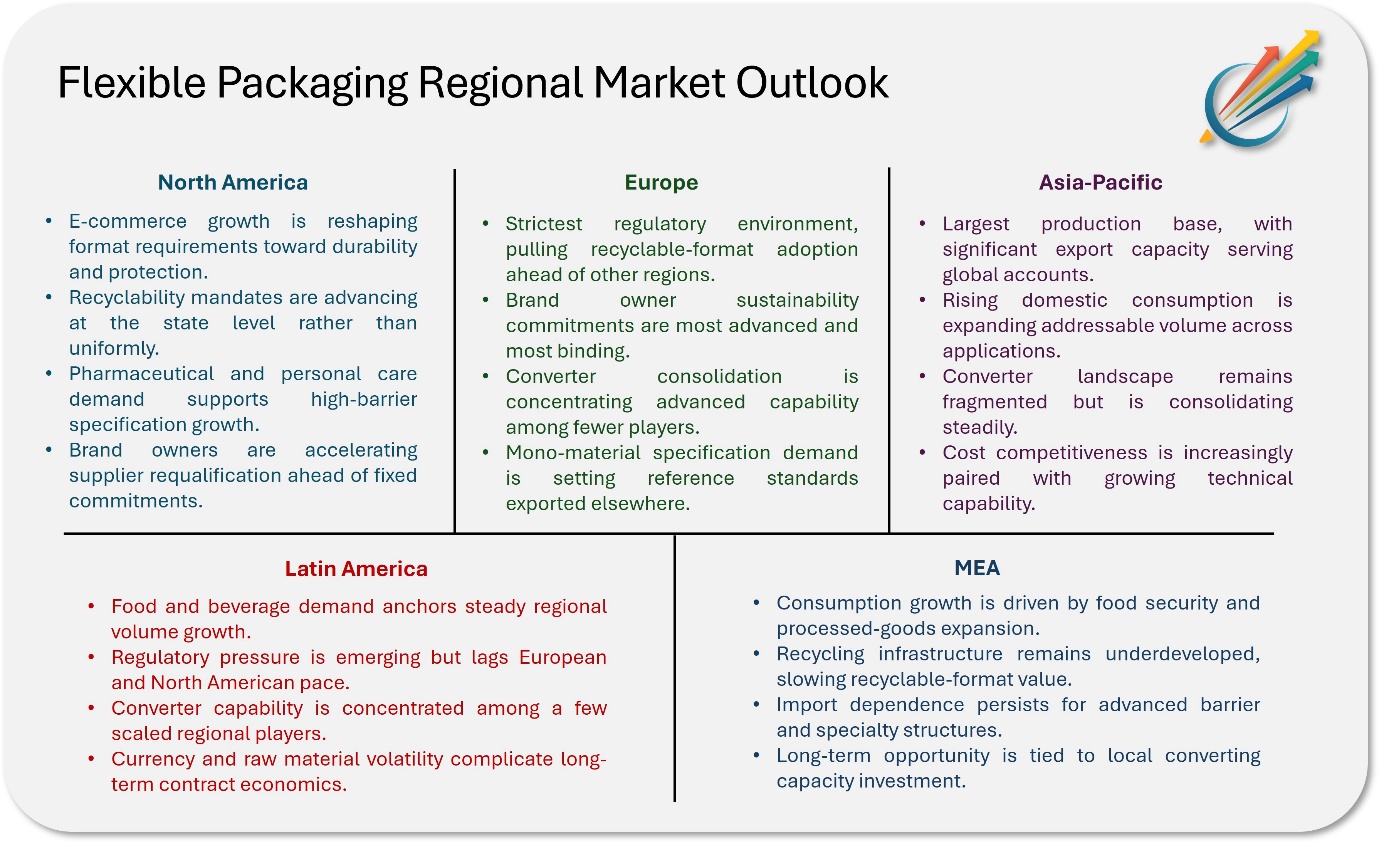
- Asia-Pacific holds the largest production base, with converter consolidation accelerating across the region.
- Barrier performance, not price, is increasingly the decisive factor in large-account supplier selection.
- Bioplastic and paper-based substrates are gaining specification share faster than installed capacity can meet.
As per Senior Analyst from Market Minds Advisory, The flexible packaging market has stopped rewarding scale alone and started rewarding material capability that scale cannot quickly replicate. Brand owners who lock in recyclable-format supply relationships over the next four to six quarters will set their packaging economics for the rest of the decade."
Narrow Strategic Window is Opening for Brands still Treating Flexible Packaging as a Procurement Exercise
The flexible packaging market is moving through a procurement reset, and the window to secure advantaged positions is narrower than most planning cycles assume.
- Recyclability mandates are pulling specifications forward: Brand owners facing 2030 commitments are requalifying suppliers now, not later. Converters without proven mono-material capability are being quietly screened out of long-term tenders.
- Capacity for advanced substrates is constrained: Demand for recyclable and bioplastic structures within the flexible packaging market is outpacing converter investment. Qualified capacity, not raw demand, is the binding constraint.
- Early movers are compounding advantages: Converters who invested ahead of the mandate cycle are now setting reference specifications. Late entrants negotiate against an installed standard rather than a blank sheet.
Flexible Packaging Market is Shifting from Volume-Led Supply to Engineered Packaging Systems
The most important change in the flexible packaging market is not volume growth. It is the redefinition of what the product actually is, moving from interchangeable film to engineered, application-specific material systems.
- Material science is now a competitive moat: Barrier performance, downgauging, and recyclability cannot be matched through pricing or scale alone. Converters with proprietary structures are capturing specification control that procurement teams cannot easily reverse.
- Sustainability requirements have raised the technical floor: Mono-material laminates demand reformulated adhesives, coatings, and sealing systems. Suppliers unable to deliver recyclable structures at performance parity are losing access to the largest accounts.
- Value is migrating upstream toward specification: The converters who co-develop packaging with brand owners, rather than quote against finished drawings, are claiming the durable margin. Treating film as a strategic asset rather than a procurement step is becoming the dividing line.
Flexible Packaging Market Evolving Faster than Most Packaging Transition Strategies Anticipated
The consensus expects a smooth transition to recyclable formats. The more likely outcome is a multi-year capability gap, where demand for mono-material structures runs well ahead of qualified converter capacity, leaving brand owners competing for limited advantaged supply.
Plastic is widely framed as the segment in retreat. In practice, recyclable polyethylene and polypropylene structures are absorbing much of the sustainability shift, while paper-based substitution proves slower and more application-limited than headlines suggest.
Most commentary treats price as the enduring battleground. The more decisive contest is qualification speed. Converters who can certify recyclable structures fastest will control account access well before cost competition resumes as the primary lever.
A New Competitive Structure Is Forming Across the Flexible Packaging Market Ecosystem
Regulatory Convergence on Recyclable Design
Extended producer responsibility schemes and packaging waste regulations across major markets are converging on a similar requirement set. Multi-material laminates that resist recycling face escalating fees and design restrictions. This regulatory pressure is forcing the flexible packaging market toward mono-material structures, and the converters who anticipated the direction are now positioned to serve accounts that latecomers cannot.
Brand Owner Sustainability Commitments
Large consumer goods companies have published recyclable-packaging targets with fixed dates, and those commitments now flow directly into supplier qualification. Procurement is being measured against transition milestones rather than unit cost alone. Converters able to evidence recyclable performance at scale are being designed into multi-year contracts, while others are managed toward replacement.
Barrier Performance Demands in Food and Pharma
Shelf-life extension, contamination protection, and product integrity requirements continue to intensify, particularly in pharmaceutical and high-value food applications. These demands raise the technical complexity of every specification. The intersection of high barrier performance and full recyclability is the hardest engineering problem in the sector, and the converters solving it are capturing the most defensible positions.
Converter Consolidation and Capability Concentration
Mergers and capacity investment are concentrating advanced capability among a smaller group of well-resourced converters. Material science, recyclable certification, and global account servicing all favor scale plus specialization. Smaller regional players without a clear technical niche face a narrowing path, and the flexible packaging market is steadily separating into capability tiers.
Ignoring Structural Risks Could Delay Competitive Positioning Across Consumer Packaging Markets
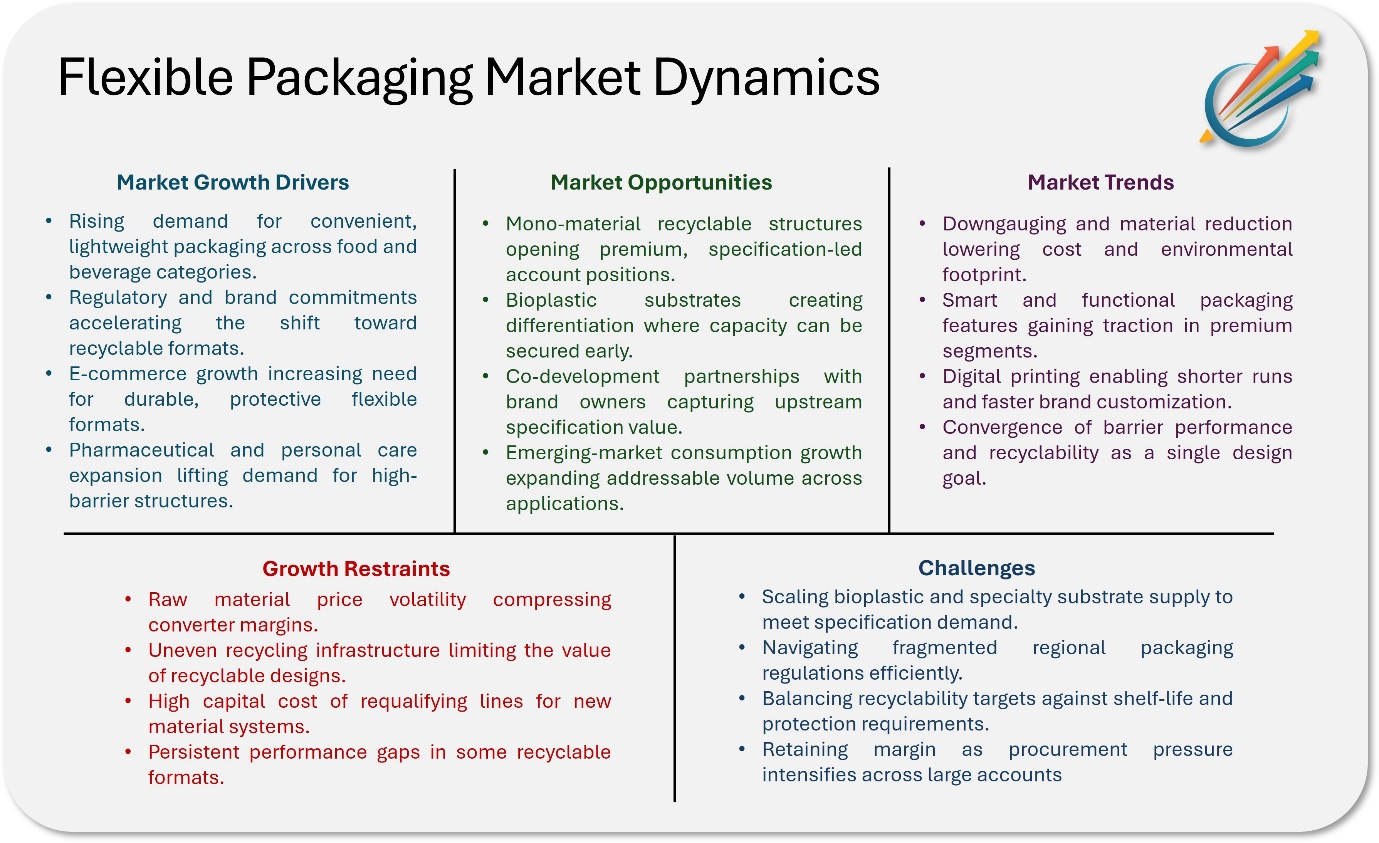
- Raw material volatility: Resin and substrate price swings compress converter margins and complicate long-term contract pricing across the value chain.
- Recycling infrastructure gaps: Mono-material designs deliver limited benefit where collection and sorting systems remain underdeveloped, weakening the sustainability case.
- Capital intensity of transition: Requalifying lines for recyclable structures demands significant investment that smaller converters may struggle to finance.
- Performance trade-offs: Some recyclable formats still lag conventional laminates on barrier or runnability, slowing adoption in demanding applications.
- Regulatory fragmentation: Divergent regional rules raise compliance complexity for converters serving multiple markets simultaneously.
- Substrate supply constraints: Bioplastic and specialty paper availability has not yet scaled to match accelerating specification demand.
These risks are real and will shape the pace of transition rather than its direction. The flexible packaging market is still set on a clear upward trajectory, but the distribution of that growth will favor the structurally prepared.
Market Dynamics Shaping the Flexible Packaging Market
Flexible Packaging Market Segmentation
By Product Type
- Pouches
- Stand-Up Pouches
- Flat Pouches
- Spouted Pouches
- Others
- Bags
- Gusseted Bags
- Wicketed Bags
- Vacuum Bags
- Wraps
- Liners
- Sachets
Pouches anchor the product mix and continue to take share from rigid formats, with stand-up and spouted variants leading premiumization in food and beverage. Bags hold steady industrial and bulk demand. Within the flexible packaging market, format choice is increasingly driven by recyclability and barrier requirements rather than cost alone, which favors converters with engineered pouch capability.
By Packaging Type
- Primary Packaging
- Secondary Packaging
- Tertiary Packaging
Primary packaging dominates value, since it carries the barrier, branding, and product-contact requirements that command technical premiums. Secondary and tertiary layers are more cost-sensitive and consolidation-prone. The strategic contest in the flexible packaging market sits firmly in primary structures, where material innovation and specification control translate most directly into margin.
By Material Type
- Plastic
- Polyethylene
- Polypropylene
- Polyethylene Terephthalate
- Polyamide
- Others
- Paper-Based Materials
- Aluminum Foil
- Bioplastic Materials
- Multi-Layer Laminates
Plastic remains the dominant material base, but its composition is shifting toward recyclable polyethylene and polypropylene structures. Paper-based and bioplastic materials are gaining specification share faster than capacity is being added. Multi-layer laminates face the steepest regulatory pressure, and the flexible packaging market is steadily rewarding converters who can deliver recyclability without sacrificing barrier performance.
By Distribution Channel
- Direct Sales
- Distributors and Wholesalers
- Specialty Stores
- Online Sales
- Supermarkets/Hypermarkets
- Others
Direct sales dominate large-account relationships, where co-development and long-term qualification matter most. Distributors serve fragmented regional and mid-tier demand. Online channels are reshaping format requirements toward durability and protection. Across the flexible packaging market, channel structure increasingly mirrors the divide between specification-led and price-led purchasing.
By Application
- Food Packaging
- Beverage Packaging
- Pharmaceutical Packaging
- Personal Care Packaging
- Household Products Packaging
- Industrial Packaging
Food and beverage applications carry the bulk of volume and set mainstream format trends. Pharmaceutical and personal care applications, while smaller, demand the highest barrier and compliance standards and deliver stronger margins. In the flexible packaging market, application mix increasingly determines which converters can justify investment in advanced material capability.
Shape this report around your priorities: https://marketmindsadvisory.com/request-customization/?report_id=18
Regional Market Outlook
Investment Focus where the Lucrative Opportunity is Anticipated
Recyclable Mono-Material Structures
The clearest value pool sits with converters who can deliver mono-material structures at performance parity with conventional laminates. Brand owners facing fixed commitments will pay for certified recyclability, and qualified capacity is scarce. This is where specification control, and therefore durable margin, is being claimed within the flexible packaging market right now.
High-Barrier Pharmaceutical Packaging
Pharmaceutical applications combine strict compliance, demanding barrier requirements, and lower price sensitivity. Converters with validated high-barrier capability and regulatory track record occupy positions that are difficult to contest. As healthcare consumption rises globally, this segment offers margin resilience that volume-led food packaging cannot match.
Co-Development Partnerships with Brand Owners
The strategic logic favors converters who embed early in packaging design rather than quoting against finished specifications. Co-development locks in multi-year relationships, captures upstream value, and insulates margin from procurement pressure. Treating the brand owner relationship as a strategic asset, not a transaction, is increasingly the dividing line.
Bioplastic and Paper-Based Capacity
Specification demand for bioplastic and paper-based substrates is running ahead of installed capacity. Converters who secure substrate supply and converting capability early can command differentiated positions before competition normalizes. The flexible packaging market is rewarding those who treat capacity reservation as a present-tense priority.
What This Means for Decision-Makers
Brand Owners - Supplier selection has become a strategic decision, not a procurement task. Locking in converters with proven recyclable-format capability now protects both compliance timelines and packaging economics through the rest of the decade.
Converters - The path to durable margin runs through material capability and early specification involvement. Investing ahead of the mandate cycle, rather than reacting to it, determines which accounts remain accessible.
Investors - The defensible positions sit with converters holding proprietary material science, certified recyclable capacity, and co-development relationships. These offer clearer risk-return profiles than scale-led, price-competing exposure.
Policymakers - Recyclable design mandates are shaping the market quickly, but infrastructure for collection and sorting must keep pace. Without it, mono-material investment delivers far less environmental return than intended.
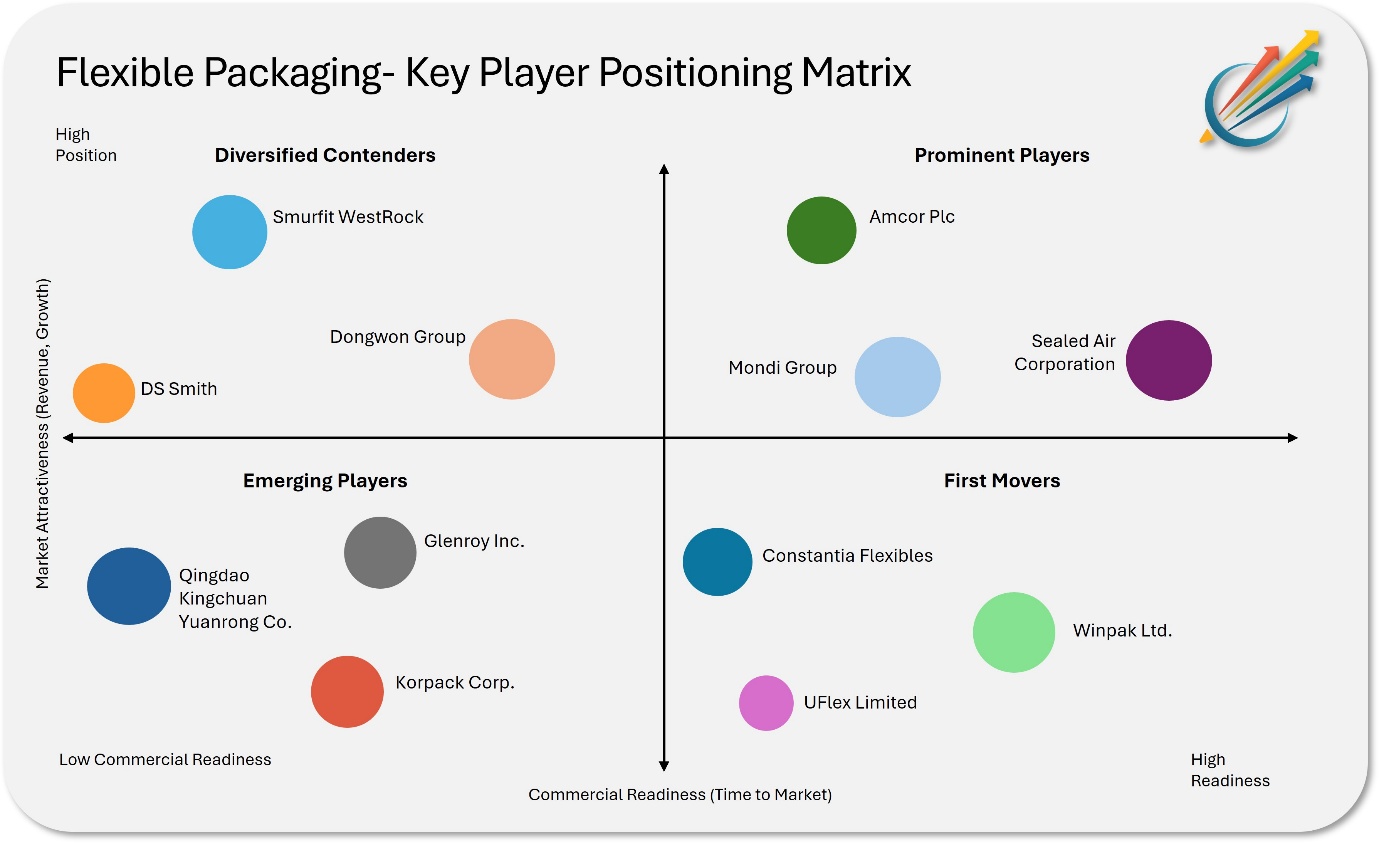
Competitive Landscape: Flexible Packaging Market
Recent Market Developments
- In April 2026, Amcor Plc advanced its portfolio of recyclable flexible packaging structures aimed at supporting brand owner sustainability commitments.
- In March 2026, Mondi Group continued investment in paper-based and recyclable flexible packaging solutions across its European operations.
- In February 2026, Huhtamaki expanded its focus on mono-material and recyclable formats within its flexible packaging business.
- In January 2026, ProAmpac broadened its recyclable and sustainable flexible packaging offering through ongoing product development.
Market is segmented by Product Type (Pouches, Bags, Wraps, Liners, Sachets), Packaging Type (Primary, Secondary, Tertiary), Material Type (Plastic, Paper-Based, Bioplastic, Multi-Layer Laminates), and Application (Food, Beverage, Pharmaceutical, Personal Care)
Get Access to complete Analysis, Buy Now: https://marketmindsadvisory.com/buy-now/?report_id=18
Trending Reports
- Packaging Barrier Film Market
- Packaging Automation Market
- Pack Conveyors Market
- Overcaps Market
- Overwrapping Machines Market
- OPP Pouches Market
- On-The-Go Pots Market
- Oily Waste Can Market
- Octabin Market
- Nursery Grafting Tape Market
Why choose Market Minds Advisory
Market Minds Advisory delivers decision-grade intelligence to executives across machinery, packaging, chemicals, automotive, ICT, food and beverage, consumer goods, and healthcare. We help organizations sharpen market expansion strategies, accelerate share gains, refine brand positioning, and enable account-level growth. Our forecasting integrates primary interviews, proprietary demand models, and continuous market validation, producing the kind of clarity volatile and emerging industries require. Backed by over a decade of sector expertise, our research surfaces white space, opportunity gaps, and competitive blind spots, accounting for recent developments and geopolitical risk. We help businesses see the future of their markets.
Contact Us
Market Minds Advisory
1521 Concord Pike, Suite 301
Wilmington, DE 19803
United States
Email: sales@marketmindsadvisory.com
Website: https://marketmindsadvisory.com/